Get ready to vote: Your guide to the school board election on the South and Far South Side
You asked, and we answered. Here’s all the information South Siders need to prepare for Election Day and be heard in the 2026 Chicago Board of Education election.


What does the school board actually do?
The Chicago Board of Education oversees a school district serving more than 300,000 students.
Board members vote on the CPS budget and capital improvement plan, district policies, major contracts and agreements, school calendars, school improvement plans, charter school agreements, and certain personnel decisions. The board also hires and evaluates the district’s chief executive officer.
Those powers can translate into decisions about whether schools have enough teachers and support staff, which buildings receive improvements, how programs are funded and what happens when schools lose enrollment.
For voters, that is why who sits on the board matters. Board members are making choices about how limited district resources are distributed and which needs receive priority.
What's the biggest issue facing the next board?
The people elected in November will inherit a school district already facing serious financial questions.
CPS entered the school year with a budget fight over how to close a deficit of more than $700 million while avoiding cuts to schools.
In July, the board amended the district’s proposed budget in an effort to reverse more than 1,000 layoffs while counting on an additional $150 million in state funding that lawmakers had not approved.
The disagreement continued into August as board members and district leaders discussed how CPS could find more money in the short term while addressing its financial problems over the long term.
That matters to families because budget decisions do not stay inside CPS headquarters. They can determine whether a school has a teacher, counselor, classroom assistant, arts program, or other resources families rely on.
Which race is on my ballot?
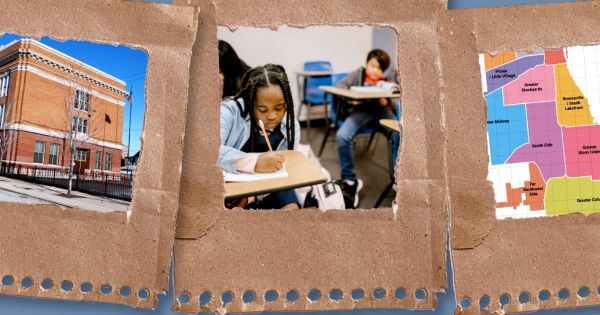
Chicago’s Board of Education has 21 seats: 20 district representatives and one board president. Chicago is divided into 10 school board districts, and each district is divided into two subdistricts, A and B. That creates 20 subdistricts across the city.
On Nov. 3, voters will cast two school board votes: one for the candidate running to represent their subdistrict and another for the president of the Chicago Board of Education, who will be elected citywide.
The races to watch on the South and Far South Side are in Districts 6, 8, 9, and 10, including subdistricts 6A, 6B, 8A, 8B, 9A, 9B, 10A, and 10B.
Your school board subdistrict is based on your home address, and the boundaries don’t always follow neighborhood lines. The easiest way to know which subdistrict you’re voting in is to look up your home address.
Use the Chicago Board of Education’s address lookup to find the district that represents your home.
Who’s running for school board president?
For voters in 9A and 10A, the citywide race for school board president still gives them another choice to make on the ballot. Every Chicago voter will also choose the next president of the Chicago Board of Education.
Four candidates are running for the citywide position: Jessica Biggs, Hilario Dominguez, Victor Henderson, and Sendhil Revuluri. The field narrowed last week when incumbent Jennifer Custer dropped out, citing the millions that special interests are expected to spend on the race.
The board president leads meetings and has responsibilities separate from those of individual district representatives.
What should you ask the candidates?
Paulus has spent roughly 14 years connected to CPS through his children and Local School Council service. He also wants voters to consider whether candidates are willing to disagree with the people and organizations they normally align with.
“It’s easy to complain about somebody who is different from you,” said JP Paulus, a CPS parent and longtime Local School Council member who lives in Bronzeville. “But when a candidate disagrees with people they would normally side with, he wants to know, “What did you say and how did you resolve that?”
How do I vote in the school board election?
Election Day is Tuesday, Nov. 3. Chicago voters will make two school board choices: one for the representative of their subdistrict and another for the president of the Chicago Board of Education.
Your home address determines which of the 20 subdistrict races will appear on your ballot. Because each of the city’s 10 school board districts is divided into A and B subdistricts, voters living in the same general area may not necessarily vote in the same school board race.
The last day to register to vote online is Oct. 18. After that, you can still register in person at an early voting site or at your polling place on Election Day with two forms of ID. Early voting begins in all 50 wards on Oct. 19, and the deadline to apply for mail-in ballot is Oct. 29.
You can use the Chicago Board of Education's address lookup tool to find your subdistrict and current board representative.
Do I need an ID to vote?
If you're already registered and your signature matches what's on file, no.
If you're registering for the first time at an early voting site or on Election Day, yes. You’ll need to bring two forms of ID, at least one showing your current address. You'll also need it if you registered by mail without providing a driver's license number, state ID number, or the last four digits of your Social Security number.
What if my polling place doesn't have me on its list of registered voters?
Tell a poll worker your address. They can confirm whether you're in the right place. If you are and you're still not listed, you can cast a provisional ballot. Election officials verify your registration afterward, usually within two weeks, and your vote counts once they do.
How do I get to my polling place if I can't drive myself?
CTA buses and trains run to polling places across the South and Far South Side. Ride-share companies like Uber and Lyft have offered free or discounted rides to the polls in past elections, so it's worth checking their apps closer to Nov. 3 for this year's deal. We’ll report on any transportation deals to the polls as they come up. Follow @thevpchicago on Instagram for updates.
What do I do if I have a problem while voting?
Tell a poll worker first. If they can't fix it, call the nonpartisan Election Protection hotline at 866-OUR-VOTE (866-687-8683). Help is also available in Spanish, Arabic, and several Asian languages through the same hotline.
Can people bring guns to the polls?
Illinois doesn't have a standalone law banning firearms at every polling place. But most polling sites double as schools, libraries, or other government buildings, and the state's concealed carry law already bars guns from those buildings regardless of what's happening inside them that day. A bill that would ban firearms at all polling places outright has been debated in Springfield but hasn’t passed yet.
If you see someone with a gun at your polling place and feel unsafe, tell a poll worker or call the election protection hotline.
How can I stay involved after Election Day?
Families do not have to wait until Election Day to make their voices heard. Chicago Board of Education meetings are open to the public and livestreamed online. Residents can register to speak during public participation or submit written comments to the board.
After the election, families can continue following board meetings, contacting their representatives, and asking how decisions will affect their schools and communities. For South Side and Far South Side families, knowing who represents you is one step. Paying attention to what they do once they take office is the next.